Experience Designer & Accessibility Champion

How Accessibility Became Everyone’s Business
When I first joined N-able, accessibility wasn’t really part of the conversation. Our products were powerful, but not always usable for everyone. It wasn’t neglect, it was the usual story of “we’ll fix that later.” But later never came.
So I decided to start small.

My Role
Leading UX Designer,
Accessibility Champion

Team
UX Director, CTO, Design System Team, Engineering, PM, Staff Design

Status
Ongoing work
Design System level
Glossary
GAAD
Global Accessibility Awareness Day
A11y
Accessibility
VPAT
Voluntary Product Accessibility Template
WCAG
Web Content Accessibility Guidelines
Building Awareness & Finding Allies
When I joined N-able the company was not considering or talking about accessibility. I really wanted to know more about this subject so, although it was disappointing I won't have specifically someone I can learn from, my team really supported me in my learning and exploring endeavours.
The first step was to simply read as much information that was available to me so I can then pass on that knowledge to my team. I then completed the full Deque University training, earned my certificate, and dove into every conference and more resources I could find. I spent nights watching talks, rewinding WCAG breakdowns, and pestering my screen reader to understand how things actually sounded, not just how they looked.
The journey for me has just began but it is a good feeling to know that what I am doing is the right thing for all users


Started to make some noise
Once I felt like I had enough information to confidently make some noise around the office, my director encouraged me to use the moment that our CTO (Chief Technical Officer) is in the office and deliver a presentation. I wanted to make something fun so at the end we also did some testing activities using, keyboard navigation and Screenreader. Not long after our CTO asked me to, lead a live demo for 500 people showing what good keyboard navigation looks like when it’s done right. Which sparked some very interesting conversations!
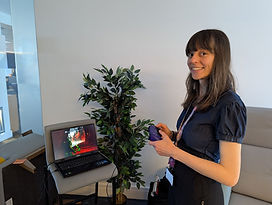
After it was time to organise our first Global Accessibility Awareness Day (GAAD) event. We prepped, research activities, feedback boards with stickies, even invited Triple Tap Tech charity who had their own setup of accessible gaming. It was great fun and people were able to learn something new.


Turning talk into tools
Advocacy only goes so far without something tangible. So I worked with our design system team, a staff designer, developer, and architect, to bake accessibility right into the building blocks of our products.
I wrote acceptance criteria, added annotations in Figma files, and tested every component like a keyboard user would. I’d check in with developers often, not to chase but to help, sharing context, test results, and what “good” looked like in practice.
We didn’t solve everything overnight, but every audit, every prototype, every accessibility note made our work a little stronger and our process a little smarter.

Outcome
Today, accessibility is baked into our design tokens and components in Figma.
We’ve now an accessible focus states, documentation that grows and will hopefully grant us VPAT at some point. What is more important teams now talk about accessibility, and we don't experience that much resistant anymore.
It’s still a work in progress, but that’s the nature of accessibility: it’s never “done.”
And that’s what I love about it.
Every small improvement makes someone’s experience better, and that’s a kind of progress worth fighting for.
Key learnings
-
Learning deeply before leading helped me influence others with confidence, not just conviction.
-
One GAAD event turned into cross-team awareness, conversations with leadership, and lasting cultural change.
-
Demos, audits, and simple, shareable insights made inclusion tangible for people who’d never thought about it before.
-
Embedding accessibility in components and design tokens showed that steady, practical steps matter more than sweeping promises.
-
Working side-by-side with developers and architects turned accessibility from “extra work” into shared craftsmanship.
-
Shifting mindsets is as much a design challenge as any interface, just with different user flows.
Next steps
-
Continue creating documentation and annotations of patterns and components
-
Continue testing the Accessibility Maturity Model of our organisation
-
Prepare strategy how we make N-able accessible by 2030
-
Create a road map to reach our north star
-
Create training for teams
And loads more .....
